

"I don't have ADHD"
Part One

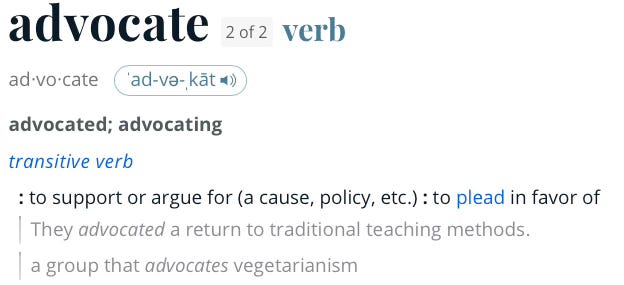
Merriam Webster defines the verb “advocate” as “to support or argue for (a cause, policy, etc.)” and “to plead in favor of” something.
This is the beginning of a story about accidentally advocating for the way I think, the way I learn, and the way I process the world. Like the reporter, Danielle Elliott, says in a recent podcast series I highly recommend, I didn’t want to have ADHD.
My story begins with me flat out denying an ADHD diagnosis as even a consideration in my world.
For the past three years, my immediate family and I noticed that my exhaustion levels were becoming untenable. I could barely make it through a day without napping at least once (a privilege, but an exhausting one). To make matters worse, my trusty method of downing a double espresso latte or two to snap me into action was not having the same start-up effect as it used to. The days were blurring together, the array of thoughts inside my brain was seemingly short-circuiting with what I was trying to say and do aloud, and getting started with nearly every kind of task felt like a Herculean feat.
During this same period, I also turned 40, finished my 4 year 5.5-year-long doctorate program, and started job searching for my first post-doctorate role.

One could argue that these developments alone would make a person:
Burnt out (did I mention my doc program was interrupted by a global pandemic?)
Slightly depressed (hello, a million job applications with zero feedback or recognition)
Even a bit exhausted (40? How! And what do you mean perimenopause can begin up to 10 years before menopause?!)
Well, one could argue, and I did argue with myself, that everything was 🎶as it was🎶 because of how things were colliding for me at this moment in time.
And yet about a year ago, I continued to elaborate on all of these changes and frustrations to my counselor, a professional I’d been speaking to for about two years as routine maintenance for my long-diagnosed generalized anxiety. It was late summer 2024, and I remember her pausing as she offered a careful preface to what she said next.
“I hesitate to say this because this is not my area of expertise.
However, I feel at this point I would be doing you a disservice if I didn’t tell you that many of the women I work with who are around your same age and experiencing very similar symptoms are receiving late-ADHD diagnoses.
Perhaps this is something you should bring to another professional who can guide you in this possibility?”
As I listened to her words, I went from being hopeful about what she was going to say, right back to frustrated in the blink of an eye, because surely I didn’t have the young-boys-who-can’t-sit-still condition! I appreciated her concern in sharing this with me, but ultimately dismissed her feedback. Yes, I knew of a couple of female graduate colleagues during my doctorate who also experienced this story of a late-in-life diagnosis, but no, this didn’t apply to me.
And so I kept languishing. White-knuckling my daily tasks into submission, missing deadlines here and there, saying yes to a couple of new opportunities while wondering if I could actually handle them, and always, always wondering when I could lie down next just to pause my exhausting brain. The ideas I wished I could put into action kept churning, the should-be-doing storyline was building momentum, and the what-is-happening-to-me questions kept going.
It felt like my old coping mechanisms and savvy tricks for being a productive person were suddenly operating on an outdated system that I couldn’t download an update for.
Until one day, my algorithm caught up to these suggestions I’d been ignoring. A woman whose social media account I’d been following for about six months because of her public journey with narcolepsy - a fascinating rabbit hole for someone who is always, always in need of more sleep - was posting about something new. Her recent diagnosis with late-in-life ADHD and the manifestation of ADHD for women, including many aspects of her life that she didn’t know were symptoms.
As I thumbed through these symptoms, I was hit in the face with the concept of “time blindness” along with the idea of hyperactivity in ADHD not only existing in the physical body but also the mind.
Let me break this down.
First, I was introduced to the concept that essentially says people with ADHD experience and process time differently. Time is non-linear and hard to see or grasp, even more so than for a neurotypical person, and this often explains why people with ADHD procrastinate and are often late.
I cringed when I read this.

I don’t procrastinate! I thought as I became flooded with hundreds of memories of late nights grading in the final hours before grades were due, finishing a job application minutes before its deadline (even though I knew about it for weeks), and don’t get me started on the countless awkward meetings with my dissertation chair about where I was on the chapter revisions we discussed previously. “I think this will take me two weeks,” almost always became two months- or more.
I’m not always— I couldn’t even finish that thought about being late, because anyone who knows me has known I run at least 15 minutes behind to anything. Well, let’s correct that statement - I can get to places on time so long as I set multiple alarms, write myself a reminder, and have at least one other family member yelling at me to get out the door / finish up / hurry along.
I am the person for whom you have to tell a fake time to if you want me to arrive at the correct time. I have berated myself for this “character flaw” for about 30 years. I have sweat through a million rushing scenarios and made up many different excuses for the awful person I am because I can’t get anywhere on time without an exorbitant amount of effort.
But I can just— Part of my procrastination and lateness is because I believe I can accomplish certain tasks in less time than they actually take. I sometimes need a little pressure to get me into action. I always look at the clock and am astonished by what time has passed. I have no idea what time feels like, and now I was reading that this might be a true phenomenon that some people either experienced, or even wilder to me, did not have to experience daily.
Okay, okay, so apparently there’s this thing called time blindness, which is just what I thought was my whole life and my own character flaws, and now I’m seeing maybe it’s a characteristic of ADHD and wait, what???
My mind was churning with intrigue and doubts as I learned about this, while also processing the other notion that women with ADHD may not only experience hyperactivity in physical symptoms, but that they may experience it in the mind. A mind that:
Never turns off. Cue me being told my entire life, “Meg, why can’t you just relax? Why are you thinking about that? Why are you asking those questions right now?”
Now, this may sound familiar for those of you reading who experience generalized anxiety like I do. This is another conveyor belt of thoughts through our minds, but more particularly the ones that are fear-driven and panic-induced. As I kept reading about ADHD hyperactive minds, I was slowly realizing mine is good at the anxious thoughts AND the everyday, sometimes even quite interesting, thought spirals.
For instance, have you read the children’s book If You Give A Mouse A Cookie? I’ve often thought this story about a mouse who goes from getting a cookie to trimming his mousey whiskers illustrates the seemingly unrelated trail of events that happen on a minute-by-minute basis in the minds of those of us who identify with ADHD. (I actually loved that an #ADHD Threads discussion I’ve since lost also landed on this same comparison to much enthusiasm across neurodivergent minds.)
But okay, so back to the hyperactive mind. It never seems to shut off. It always connects patterns, finds new questions, digs deeper, goes on a tangent, forgets what’s currently happening, doesn’t know what time it is, and circles back at a new starting point. My eyes were wide open by this thought, but my mind was still a bit skeptical. I mean, gosh, was I becoming someone who self-diagnoses off of one social media post?!?

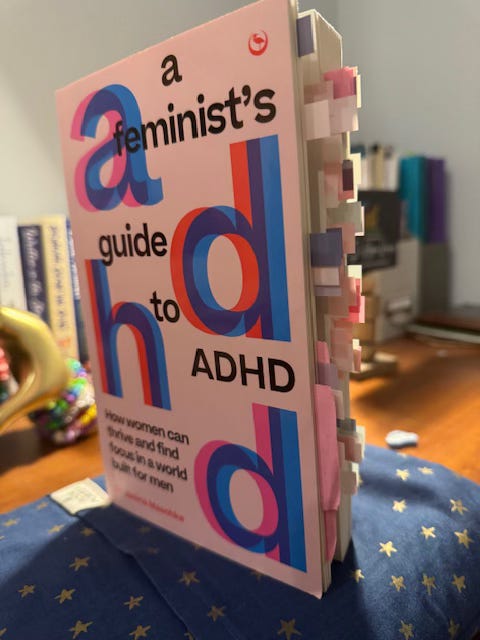
So naturally, I did what anyone (???) would do next- I ran to my local Barnes & Noble and scoured the shelves for books about ADHD. I knew of one popular title, so I found that first. However, when I picked it up, it looked okay… but the vibes were off. So I looked, and looked again, and then I looked around that shelf again, and soon landed on a book I’ve mentioned before, A Feminist’s Guide to ADHD: How women can thrive and find focus in a world built for men by Dr. Janina Maschke. I figured if anything I was seeing on this social media post was true, it would be validated and presented in more detail by an expert. I took the book home then I proceeded to lock in (ahh, there’s an ADHD word for this too: hyperfocus) and read the book, cover-to-cover, over the course of about three days. Which I need to add right here, is not typical for me. I am a notoriously slow reader! Even my most recent five-star book took me a week to finish.
What happened in these three days can best be seen below:
I was learning a great deal in a short amount of time about a topic that was increasingly staring me in the face for my attention (ha!). And it felt like I was an hourglass being tipped upside down over and over again as the way I saw my past shifted in tandem with the questions I had about my present experiences. Here are some highlights from my deep dive:
“On average, boys receive their ADHD diagnosis around the age of 7, whereas girls tend to get diagnosed much later, typically in their late 30s or early 40s” (p. 17). Late 30s, early 40s. Got it.
“Often referred to as the ‘feel-good’ chemical, higher serotonin levels contribute to feelings of happiness and calmness. However, ADHD’ers frequently experience lower serotonin levels, leading to challenges in emotional regulation, increased irritability and difficulties with concentration” (p. 35). And is a chemical that people with generalized anxiety are already lacking!
“Norepinephrine is essentially adrenaline for your brain. Just as adrenaline stimulates your body, norepinephrine activates your brain. Its levels are low during sleep and upon waking…. An ADHD brain has lower and imbalanced levels of this neurotransmitter” (p. 36). Let me add here that I have NEVER been able to wake up easily in the mornings. As in multiple alarms, annoy everyone around me, trapped in quicksand feelings, finally get out of bed just to battle the storm of thoughts in my brain and pray I don’t run late. Always thought it was because I didn’t try hard enough at morning routines…
“For many women, all their symptoms happen in their head, and they direct all the resulting anger and frustration toward themselves. They often suppress their emotions, anger and frustration, and are reluctant to seek help or share their experiences with others. This internalization of symptoms makes their ADHD much less apparent to those around them” (p. 42). It nearly took my breath away to consider that my constant internal struggle with self-criticism might actually be coming from a biological difference.
Hyperactivity doesn’t have to be a purely physical trait. It “can mean that you have racing thoughts and a hyperactive mind, (✅) or you might excessively fidget, tap or talk” (p. 70). I recently attended the graduation ceremony of some close friends, with another dear friend visiting from out of town by my side. When I started bobbing my leg up and down five minutes into the hours-long ceremony, she said, “Ah, yes. The leg moving. I remember this now.” She had kindly referenced the fidgeting flurry I go into during any sustained attention activity, including Sunday Mass as a child where my mom would inevitably whisper across the pew for me to “Stop moving!”
Impulsivity can also look different than skydiving or going 110mph down the freeway. “Interrupting people’s conversations, blurting out answers or words, making careless mistakes or suddenly finding yourself in the midst of cleaning the entire kitchen and reorganizing every cabinet are also all signs of impulsive behaviour” (p. 70). Gosh, does frequently interrupting others “count” if I’ve actively worked on improving this over the years? And doesn’t everyone accidentally order pizza from another state or show up at the wrong location… more than once?
“Some women might not notice that they have ADHD until they enter perimenopause. While enough oestrogen was produced and circulating in the body, they may have been able to mask their ADHD fairly well or handle life as it came. However, once there is a drastic drop in all the hormones that affect ADHD, the ADHD symptoms become more pronounced” (p. 115). The ADHD symptoms become more pronounced when perimenopause begins.
These statements, plus about a hundred others all furiously tabbed, gave me pause.
They brought me back to my counselor’s words and advice to consider this with a trained professional.
They cracked open a window into my brain that I didn’t even know was built into the wall.
And so. By the time I finished this book, binged some related podcast episodes, and began to collect a few relevant studies, I knew what I needed to do. Therefore, over the next week, I mustered up the focus and courage to message my general practitioner for an appointment. A chance to revisit some of my conversations with her about my anxiety symptoms and share some potentially new insights.
As you might have seen in the subtitle to this post, the time leading up to this appointment is Part One of my accidental advocate story.
I’ll share how my doctor responded when I presented her with this new information and the steps that followed in Part Two.
As always, and I mean it more every time, thank you for reading Only Time Will Tell.
Oh and thank you for this: “🎶as it was🎶”! 🙂
So relatable! This describes my early days and weeks of discovery, too. Loved reading this, thanks for sharing.